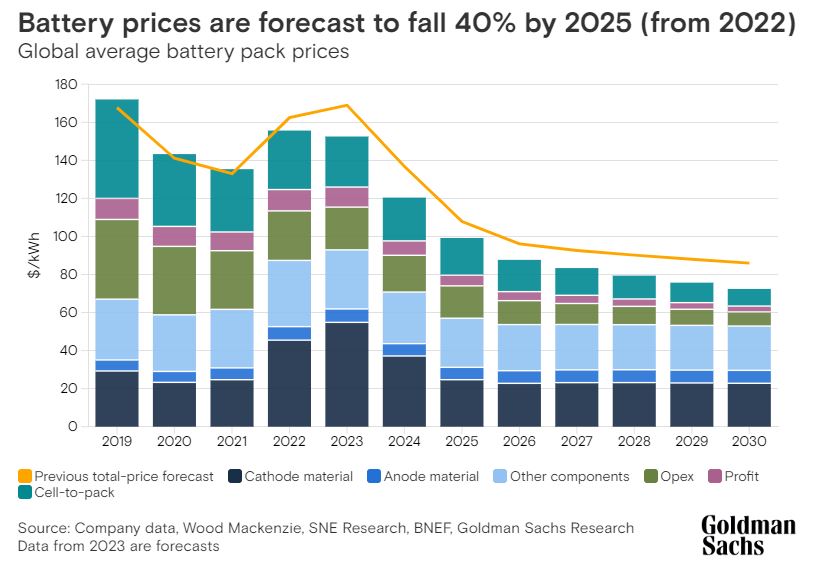

Electric vehicle (EV) battery prices are forecast to fall by 40 per cent by 2025, according to global financial giant Goldman Sachs, and will help deliver overall cost parity for electric vehicles by that date.
The latest forecasts by Goldman Sachs predicts an abrupt end to the recent “greenflation” for batteries used in electric vehicles, that stemmed from rising demand and component shortages.
Goldman Sachs now expects battery prices to fall to $US99 per kilowatt-hour (kWh) of storage capacity by 2025 – a 40% decrease from 2022. Previous forecasts had predicted only a 33% decline over the same period, highlighting the rapid shifts in the industry in just the last few months.
Almost half of this 40% decline will come from declining prices in EV raw materials such as lithium, nickel, and cobalt, and this will in turn lead to battery pack prices falling by an average of 11% per year through the end of the decade.
Most important then is Goldman Sachs’ conclusion that electric vehicles could reach cost parity, without subsidies, with ICE (internal combustion engine) vehicles around 2025 on a total-cost-of-ownership basis.
“The reduction in battery costs could lead to more competitive EV pricing, more extensive consumer adoption, and further growth in the total addressable markets for EVs and batteries,” said Nikhil Bhandari, co-head of Goldman Sachs Research’s Asia-Pacific Natural Resources and Clean Energy Research.
Goldman Sachs’ analysis further predicts that the electric vehicle market will begin transitioning away from reliance on government subsidies – which have begun diminishing, leading to a retreat in global EV penetration – towards widespread consumer adoption.
In fact, despite a recent retreat, Goldman Sachs predicts global EV penetration will jump to 17% in 2025, up from only 2% in 2020, before ramping up to 35% by 2030 and 63% by 2040.
Finally, Goldman Sachs finds that China continues to lead the way and “could be the closest to a consumer-led EV adoption phase,” according to Bhandari.
This is helped by the fact that many Chinese EV manufacturers are selling EVs at a loss, but also by the fact that Chinese consumers have access to a greater array of EV models. In comparison, EVs available in America and Europe are primarily in the larger and more luxurious categories.
Joshua S. Hill is a Melbourne-based journalist who has been writing about climate change, clean technology, and electric vehicles for over 15 years. He has been reporting on electric vehicles and clean technologies for Renew Economy and The Driven since 2012. His preferred mode of transport is his feet.
Source: thedriven.io