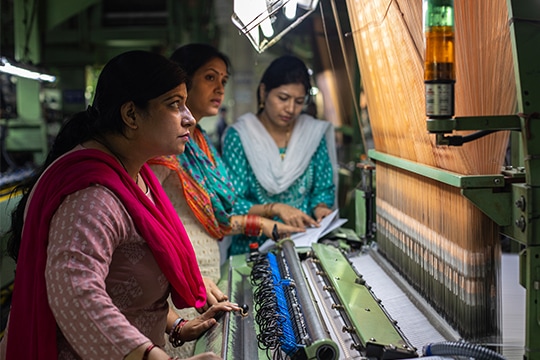

Among major economies, India enjoys a unique demographic advantage. A large share of its population is poised to enter their working-age years, and India’s age-dependency ratio—the share of economically dependent people compared to the working-age population—will be one of the lowest among major economies.
To further capitalize on this 20-year window of favorable demographics, India needs to boost its female labor force participation rate (LFPR), writes Chaitra Purushotham, Bengaluru head of Goldman Sachs Research. Just bringing the overall labor force participation rate to previous peak levels can add about 1 percentage point to India’s potential growth, all else being equal.
We talked to Purushotham about why the female share of India’s workforce has remained low over the decades, why it has now started to rise, and what implications that holds for India’s economy.
Could you describe the trends behind India’s broad, 20-year window of favorable demographics?
India’s demographic transition is unfolding more gradually and over a longer period than we’ve seen in many other Asian countries. The main reason is that both birth and death rates are declining at a slower pace in India. As a result, over the next two decades, we believe India will have one of the lowest dependency ratios among major economies. That means there will be a relatively small proportion of people who are either under 15 years or over 65 years compared to the working-age population (15-65 years). We believe this will create a powerful window of opportunity for the country.
At present, how does women’s participation in the Indian labor force compare to that of developed and emerging economies?
Right now, women’s participation in India’s labor force is significantly lower than what we see in major developed and many emerging market economies. According to the International Labour Organization, only about 31% of working-age women in India are in the labor force, relative to 54% in other major economies. Official Indian labor statistics show a higher participation rate, possibly because they count unpaid women workers who assist in household and other non-farm activities.
Declining fertility rates will eventually impact India’s labor force. How can the participation of women in the workforce offset that, and what kind of economic impact could we project by raising female participation?
Well, as fertility rates decline, the pace of growth in India’s labor force will naturally moderate. However, one way to offset the economic impact of this demographic shift is to boost women’s participation in the labor force. We think creating more employment opportunities for women and encouraging their entry into jobs can potentially raise female labor force participation. Based on our prior estimates, just bringing the overall labor force participation rate to previous peak levels can add about 1 percentage point to India’s potential growth, all else being equal.
Source: goldmansachs.com