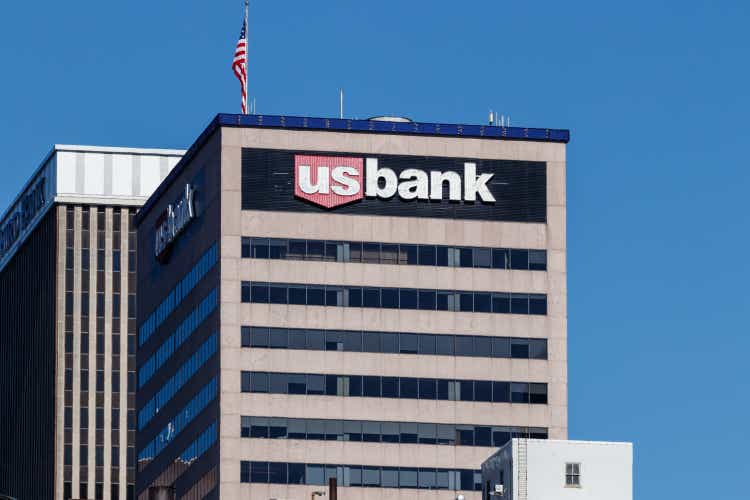

jetcityimage/iStock Editorial via Getty Images
Writing about U.S. Bancorp (NYSE:USB) last July, I thought there were more interesting candidates among this bank’s large bank brethren, and the shares have since underperformed by around 10%, with others like PNC (PNC), Truist (TFC), and Wells Fargo (WFC) outperforming, though I also tapped JPMorgan (JPM) and Citigroup (C), which haven’t done as well.
That underperformance comes despite the announcement of what should be a value-creative deal with Mitsubishi UFG (MUFG) Union Bank, and I believe reflects both some ongoing lackluster operational results at U.S. Bancorp and the market’s general skepticism around whole bank deals.
With that underperformance, I’m finding more to like in these shares. I do think U.S. Bancorp could be setting itself up for disappointment again on operating leverage in FY’22, but I do like the Union Bank deal, the ongoing investments in IT and fee-generating businesses like payments, and U.S. Bancorp’s ability to use a digital-backed “land and expand” branch-lite model to enter new markets.
Sluggish Results Despite Strong Loan Growth
U.S. Bancorp’s fourth-quarter results were an odd mix of good news and bad news, but basically underwhelming results on a core operating basis, with surprising (to me) weakness in the payments business despite the ongoing recovery from the pandemic-driven downturn.
Revenue declined 2% year over year and 4% quarter over quarter, missing by about 1% or $0.03/share. Spread income was down 2% yoy and almost 2% qoq, but that was still good for a small beat. Spread income was driven by strong earning asset growth (up 4% qoq, on strong lending), but weak spreads, with net interest margin down another 13bp to 2.40% – well short of the 2.47% average sell-side estimate. A lot of this was driven by the impact of PPP roll-off and more forgivable or understandable in my book.
Fee-based income declined 1% yoy and more than 6% qoq, missing by around 3% or $0.045/share. There was weakness in a lot of areas, including a 3% decline in cards on 7% sequential volume growth that was soft compared to Citi, JPMorgan, and Wells Fargo, though more on par with Bank of America (BAC), as well as a 7% decline in merchant processing revenue and a 1% decline in corporate payments.
Operating expenses were once again higher than expected, rising 5% yoy and 3% qoq and missing by around 2% (or close to $0.03/share). Pre-provision profits declined 10% yoy and 13% qoq, a soft performance compared to many peers and about $0.06/share below Street expectations.
Loan Growth Is Coming Back Nicely
U.S. Bancorp posted average loan growth of 2% on a qoq basis, but over 5% on an adjusted end-of-period basis. Residential mortgages were up about 2%, card loans up a little less than 2%, and auto loans up about 6%, while end-of-period adjusted C&I loans were up almost 13%. Not surprisingly, U.S. Bancorp reported a meaningful improvement in commercial line utilization.
U.S. Bancorp’s ability to maintain loan growth will be an important revenue driver in FY’22. This bank is on the lower end of the curve for asset sensitivity, and I don’t expect rates to have a transformative effect on near-term growth (loan yields were actually down more here qoq than for most other banks I’ve analyzed).
Loan growth will also be an important driver elsewhere in the income statement. Management is calling for “at least” 100bp of operating leverage in FY’22, and that’s a projection that investors would do well to take with a grain or two of salt, given U.S. Bancorp’s poor history over the last several years in living up to its operating leverage targets.
Union Bank Looks Like A Good Use Of Capital, But Maybe Not A Slam Dunk
There had been a lot of speculation in recent years about whether or not USB would get more active in whole bank M&A, particularly growth-oriented M&A to expand the company’s presence in the fast-growing Southeast U.S. For my part, I thought whole bank M&A was an option but not a necessity, and management could afford to wait for the right deal.
The September announcement of its agreement to acquire Union Bank from MUFG in a cash and stock deal worth $8 billion was surprising in some respects, but makes sense to me. Union Bank will give USB a big push in terms of scale in California, and while the Southeast gets all the press for growth (at least among bank analysts), the reality is that the large majority of California’s MSAs are also outgrowing the national averages and average household incomes compare quite favorably.
U.S. Bancorp is definitely paying a premium relative to Union Bank’s poor recent ROTCE (around 6%), but cost synergies should be meaningful given that 80% of Union Bank’s branches are within three miles of a U.S. Bancorp branch. Moreover, I do see some potential for modest revenue synergies given Union’s lower leverage to fee income. Likewise, I think Union Bank has been “under-managed” and adding USB’s superior team should drive better results.
There is some risk here. While this deal scales up U.S. Bancorp’s presence in a key state, it won’t make Bank of America, JPMorgan, or Wells Fargo any easier to compete against. There’s also a consent order in place now at Union Bank, though USB management’s decision to essentially replace all of Union’s systems with their own should help the resolution of that issue.
The Outlook
Between an improving economy and the addition of Union Bank, my long-term earnings growth rate for U.S. Bancorp ends up moving from around 3% to closer to 4%. Capital returns will be limited until the deal is completed, but management expects to resume share buybacks in the second half of 2022. I do expect Union Bank to be an accretive deal for U.S. Bancorp, and I see a chance of 20% ROTCEs as quickly as 2023.
The Bottom Line
Between discounted core earnings, ROTCE-driven P/TBV, and P/E, I think U.S. Bancorp shares should trade in the $60s, with a near-term valuation range of $59 to around $63 and long-term total annualized return potential now in the high single-digits to low double-digits. I do see some operational challenges for U.S. Bancorp to overcome, including a lack of reliability/credibility on operating leverage targets, but given the recent underperformance and the improved earnings outlook, this is a bank worth another look.
Source: seekingalpha.com