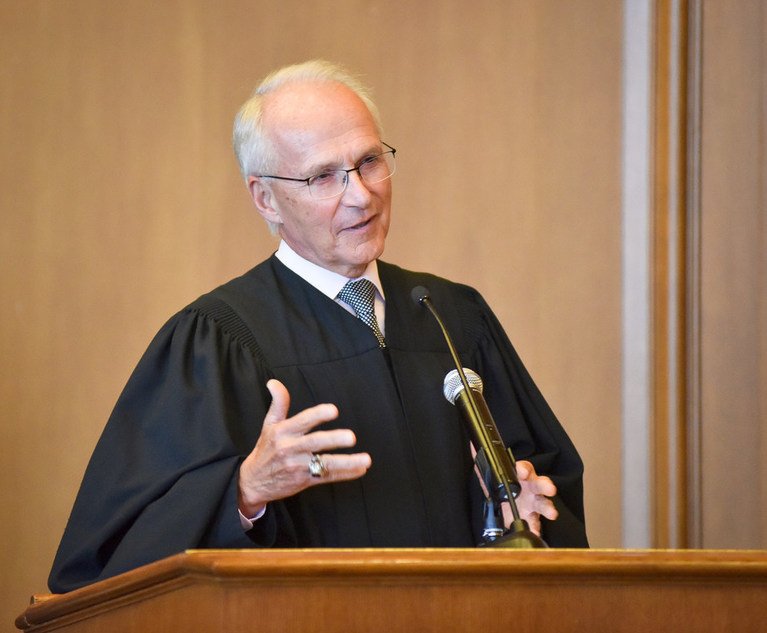

A three-judge panel of the U.S. Court of Appeals for the Second Circuit on Thursday reversed a Manhattan federal judge’s class certification in a shareholder suit against Goldman Sachs, citing guidance delivered by the U.S. Supreme Court at an earlier stage of the suit.
Circuit Judge Richard Wesley wrote for the panel, which also included Judges Denny Chin and Richard Sullivan; Sullivan filed a concurring opinion. Goldman Sachs’ attorneys include a Sullivan & Cromwell team led by Robert Giuffra and a Paul, Weiss, Rifkind, Wharton & Garrison team led by Kannon Shanmugam, while the plaintiffs’ attorneys are at Goldstein & Russell.
The ruling comes after the district court certified the class on three separate occasions in the long-running procedural history of the suit, which was originally filed in 2010 and involves shareholders’ claims that they lost more than $13 billion because Goldman allegedly made false statements about its conflicts management practices and business principles.
Wesley observed that the suit “raises challenging questions about how defendants in securities fraud class actions, having lost a motion to dismiss, can rebut the legal presumption of reliance established in Basic Inc. v. Levinson, 485 U.S. 224 (1988), at the class certification stage.”
While the parties agreed that the presumption can be rebutted if the defendants demonstrate that material misrepresentations did not impact the stock price, not all cases are so straightforward, Wesley noted.
“From there … the journey becomes difficult,” Wesley wrote. “Analyzing whether a defendant has proved a lack of price impact is complicated by the fact that a misrepresentation can affect a stock’s price either by causing the stock to trade at an inflated price, or as is alleged here, by maintaining inflation that is already built into the stock price.”
If the price eventually drops after the misrepresentations come to light, that “back-end price drop” could act as an “indirect proxy” for the front-end inflation, Wesley wrote.
“But what happens when the match between the contents of the price-propping misrepresentation and the truth-revealing corrective disclosure is tenuous?” Wesley wrote.
In 2021, the Supreme Court considered how to answer that question in the Goldman case, directing courts to “compare, at the class certification stage, the relative genericness of a misrepresentation with its corrective disclosure, notwithstanding that such evidence is often also highly relevant to the closely related merits question of whether the misrepresentation would have been material to a shareholder’s investment calculus—which, under other Supreme Court guidance, a court may not resolve at class certification,” Wesley wrote.
“In short, Goldman’s mismatch framework requires careful trekking: district courts must analyze the price impact issue without drawing what might appear to be obvious conclusions for off-limits merits questions such as materiality,” Wesley wrote.
The panel found that when the district court applied that mismatch framework, it “clearly erred in finding that Goldman failed to rebut the Basic presumption by a preponderance of the evidence, and, therefore, abused its discretion by certifying the shareholder class.”
Wesley limited the finding of error to the district court’s assessment of Goldman’s business principles statements, not the bank’s conflicts disclosure.
In his concurrence, Sullivan wrote that he would have gone further, finding that the conflicts disclosure was also generic. Sullivan also noted that he has long believed the district court erred in its assessment of Goldman’s expert evidence.
Sullivan took issue with what he described as the majority’s “circuitous” path to its conclusion, writing that it “strikes me as unnecessary and overthinks what, in my view, was a relatively straightforward directive from the Supreme Court to assess ‘all probative evidence’ of price impact.”
Sullivan also observed that the Supreme Court has created a “predicament … for lower courts tasked with assessing reliance at the class-certification stage of securities actions like this one.”
“The tension between Amgen and Goldman cries out for the court to take another look at these decisions, since courts are now forced to navigate a materiality-reliance twilight zone that is shrouded in considerable confusion,” he wrote.
A spokesperson for Goldman Sachs responded to the Second Circuit’s ruling with a statement.
“We are gratified by the Second Circuit’s decision in this case,” the statement said.
Source: law.com