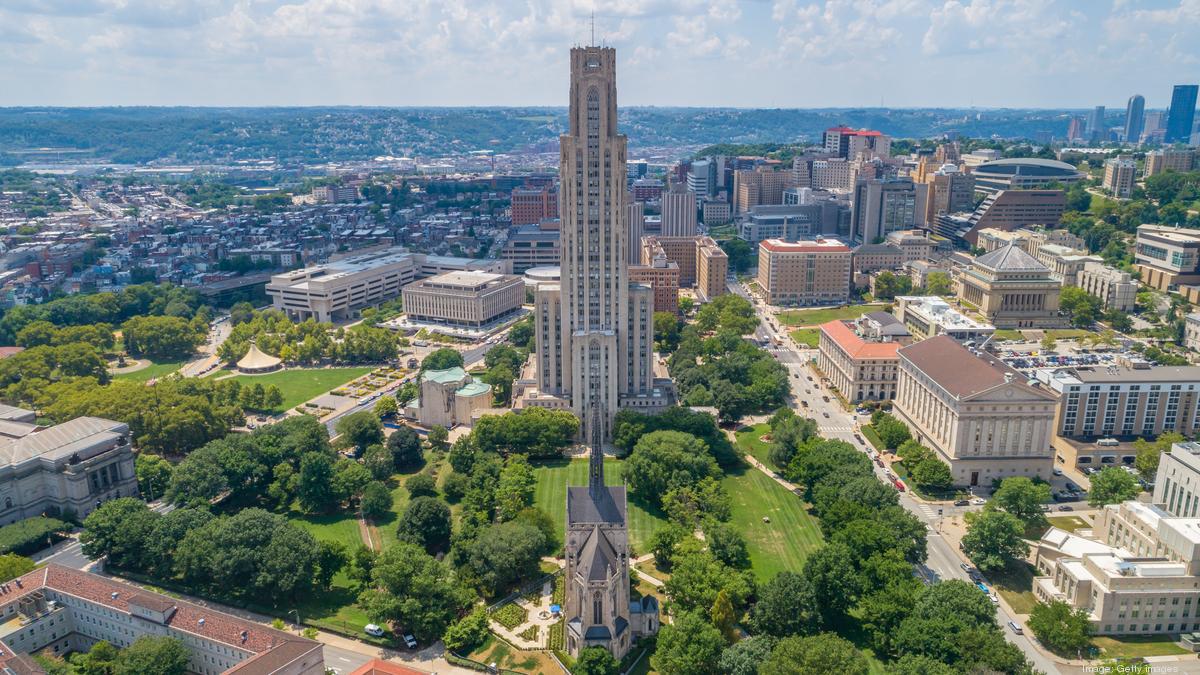

As the deadline for the state government to vote on its appropriated funding bill approaches, the University of Pittsburgh is ramping up its advocacy campaign.
Each year, through the appropriation funding it receives from the state of Pennsylvania due to its status as a state-related university, Pitt is typically able to offer in-state students a $15,000 per year reduction in tuition, something that the school, local businesses and organizations, and students and alumni say is critical to higher education access and the growth of the region’s economy. Pitt said the state funding amounts to 60% of the tuition discount and that the university itself makes up the difference.
Gov. Tom Wolf’s current 2022-2023 budget proposal includes a 5%, or $125 million, increase to the amount of appropriations funding it provides to higher education institutions. In the proposed budget, Pitt would receive over $159 million in general support funding, which would go toward the tuition discountsLast year, the university received about $151 million. A vote in Harrisburg to pass the upcoming year’s budget must take place prior to the end of June.
Yet Pitt’s funding is at risk this year in Harrisburg as lawmakers go through state budget negotiations. The funding does not have full support in the state legislature, with several Republican members speaking out against it.
Now, many local companies and groups are throwing their support behind the university.
The Allegheny Conference on Community Development is one organization that has penned its support for Pitt, with its letter to lawmakers having been signed by 52 local business leaders who are members of the Conference’s board of directors.
The letter outlines Pitt’s economic impact on the region, stating the university supports over 34,000 jobs, many of which are in the construction and building trades sectors. The letter also says the university generates $184 million annually in state and local tax revenue, imports almost $900 million in research funding, and in total, has a $4.2 billion statewide economic impact. In addition, the letter states that over the past five years, Pitt has launched 87 startups, which includes big names in the local startup scene such as Apollo Neuroscience and ALung Technologies.
Several of the letter’s signatories represent some of the region’s largest employers.
“I encourage our state lawmakers to allocate funding to the University of Pittsburgh, not only to invest in its campus community, but so the entire region can continue to prosper from the school’s academic excellence,” Bill Demchak, chairman, president and CEO of PNC Financial Services Group Inc., said in an email statement. “Like many employers, PNC benefits from the University’s efforts to attract top talent to our region. We also benefit from their reputation as a leading research university that has put our city on the map in the areas of science, medicine, education and technology. As a national bank headquartered in Pittsburgh, we experience first-hand the positive impact the University of Pittsburgh has in making this region a vibrant place to live and work.”
“As a leading public research institution and longstanding community leader, Pitt plays an important role in connecting diverse talent with companies such as PPG,” added Michael McGarry, chairman and CEO of PPG Industries Inc., via an email statement. “Attracting and retaining talent remains a key focus of our region’s job creators such as PPG and other businesses across the state. We are thankful for the role they play in strengthening Pennsylvania’s economies, workforce and future.”
In addition to local business leaders showing their support, other local university leaders also signed the letter, including Quintin Bullock, president of the Community College of Allegheny County; Kenneth Gormley, president of Duquesne University; and Farnam Jahanian, president of Carnegie Mellon University.
“Because of the strong partnership between Pitt and CMU, Pittsburgh has become one of the leading innovation ecosystems in the country,” Jahanian said via email. “Many more people will have the opportunity to participate in our economic future as a result of our collaborative efforts in a number of areas, including life sciences, advanced manufacturing, energy and information technology. Our region and state can only realize this promising future if the University of Pittsburgh continues to receive the support it needs to serve all Pennsylvanians.”
Other organizations that are in support of the university include the Pittsburgh Regional Building Trades Council, Excela Health, the Somerset County Chamber of Commerce and the business partners at Pitt’s satellite campuses, which, according to the university, are particularly at risk without the state funding. The Pittsburgh Regional Building Trades Council outlined in its letter that construction projects at the university are expected to employ over 4,500 skilled laborers within the next two years. The Pitt Student Government Board also passed a resolution urging the state government to pass the annual appropriations bill for the university.
Last year, Senate Bill 266, which allocated Pitt its funding, received 51 “no” votes in the House and 150 “yes” votes. This type of appropriation in the House needs two-thirds majority vote to pass, or 134 “yes” votes.
One issue that Republican lawmakers are taking issue with regards Pitt’s involves fetal tissue. Pitt has come under fire from conservative lawmakers, including those in Congress, for its use of fetal tissue in research. In a letter to several officials, including Attorney General Merrick Garland, Republican Senators, including Ted Cruz, alleged that the University of Pittsburgh “may have violated federal law by altering abortion procedures to harvest organs from babies who were old enough to live outside the womb,” based on records from the National Institutes of Health. In 2021, Pennsylvania Rep. Matthew Dowling, a Republican representing parts of Fayette and Somerset counties, voted “no” on granting state funding to the University of Pittsburgh, citing “fetal tissue research being conducted by the university” as his reasoning.
In 2021, the University of Pittsburgh hired an outside law firm, Washington D.C.-based Hyman, Phelps & McNamara, to do an independent review of its processes and practices for fetal tissue research, and the review found no evidence to support these claims.
“Although the use of human fetal tissue in research may not be universally accepted, federal and state laws, as well as NIH (National Institutes of Health) grants policy, permit these activities as long as certain requirements are met. We have completed our assessment of Pitt’s activities involving research using human fetal tissue and conclude that the University is fully compliant with federal and state regulatory requirements,” the law firm said in its report, issued December 2021.
The dissent in the state House and the controversy surrounding this use of fetal tissue in research is something that university leadership has dismissed as “bargaining chips.”
“We enjoy strong bipartisan support in the state Senate, as well as solid backing from the Governor and House Democrats. Some House Republicans and a select number of their leadership, however, are using unrelated issues as political bargaining chips to justify a failure to support Pitt students,” University Chancellor Patrick Gallagher wrote in a letter urging students to advocate for the funding.
Another Republican legislator has been touting a potential alternative to state funding. Rep. Eric Nelson, a Republican representing Westmoreland County, has proposed a College Voucher Program that “would provide grants directly to students interested in technical schools, community colleges, schools within the Pennsylvania State System of Higher Education (PASSHE) system, private colleges and major universities,” according to a release from Nelson’s office. The proposal was introduced as legislation on June 1 as House Bill 2639.
Nelson’s proposed program would see over $580 million in taxpayer dollars that are exclusively allocated to the state-related universities that received appropriated funding — the University of Pittsburgh, Penn State University, Temple University and Lincoln University — be redirected, and that its installment would take place over a five-year transition period, so as to not impact current students. The legislation says that for the 2022-2023 school year, Pitt would receive the same amount in state funding it received in 2021-2022. Then, every year after, the amount would decrease by 25% until the 2026-2027 school year.
The money would instead be used to provide grants of up to $8,000 to students in households with income lower than $100,000 per year and $4,000 to students in households with between $100,000 and $250,000 per year. The legislation is currently sponsored by 23 House Republicans aside from Nelson and one Democrat. It has been referred to the House Education Committee for consideration.
“During the recent budget cycle, I and a number of my colleagues expressed concerns in sending dollars directly to the non-preferred universities,” Nelson said in a statement. “Often, the policies, activities and research at these institutions do not reflect the ideals and values of the taxpayers who fund them. By expanding Pennsylvania Higher Education Assistance Agency (PHEAA) programs, we can directly empower students to choose where, and how, they invest in higher education.”
The university does not see Nelson’s solution as a viable one.
“Broadly speaking, a voucher plan would move Pennsylvania in the wrong direction,” university spokesman Chuck Finder said. “State lawmakers have invested in helping Pennsylvanians access a world-class education at Pitt — as well as fellow state-related universities Penn State, Temple and Lincoln — for more than a half-century … and this approach works. This past year, we received a record number of applications from Pennsylvanians interested in attending Pitt.”
House Republican Caucus spokesperson Jason Gottesman argues that as it stands, state funding is not the university’s only option when it comes to supplying in-state tuition discounts to students.
“Any decision about whether or not to keep in-state tuition discounts is made by the University of Pittsburgh, not by the General Assembly,” Gottesman said in a statement. “The University of Pittsburgh has an endowment of around $5 billion, one of the largest endowments in the country. That total is over 30 times the amount of the state appropriation the university received last year. It seems odd, that with such a large amount in their coffers, the first move Pitt would make when looking at the outlook for state funding is to be punitive to their students and families. As always, we are, and will continue to be, supportive of the students and families of Pitt.”
According to the university’s most recent IRS 990 form, Pitt’s endowment currently stands at over $5.68 billion. The National Center for Education Statistics ranked Pitt at No. 30 in terms of endowment size for fiscal year 2020.
However, Finder said that without the state funding, the tuition discount will completely disappear, and that so far, the university knows that “a number of state lawmakers have indicated their opposition to passing Pitt’s general appropriation.” It did not say that it would opt to go private — however, the University of Pittsburgh did report that other universities that would be affected by the funding loss are considering the option.
“Penn State Provost Nick Jones said if the state were to withdraw its funding, Penn State would likely become a private university and it likely would not be able to continue funding many of its 20 regional campuses,” the University Times reported.
Pitt, along with the letters of support from local leaders, also released student testimonies regarding the in-state tuition discount. Many students said that without the discount, they would not have enrolled at Pitt or in some cases, would not have been able to afford college tuition anywhere. Currently, with the discount for in-state students, tuition at the University of Pittsburgh’s main campus is $19,100. For out of state students, it is $34,100.
“I knew that I wanted to go to a school that would give me a really good education and not break our budget. So, Pitt was at the top of the list. So, if we had to pay an extra $15,000 more, I don’t think I would’ve come here, I probably would’ve looked into other options out of state,” said Pitt student Sam Orlowski.
“If I would have to make up $15,000 a year, I probably would not be in college right now because I would be in so much debt. College is already expensive, and it’s going up every year. It’s just too much,” said another Pitt student Doje Toussaint.
Pitt’s advocacy campaign also included a trip to Harrisburg in March for Pitt Day, where students, alumni, faculty and staff were able to advocate for Pitt’s funding directly to the legislature. Now, Pitt is urging community members to contact lawmakers in Harrisburg in support of the university.
“Students, families, businesses and community leaders across the state realize what’s at stake, and they want to make sure that their elected representatives do as well. We expect the chorus of voices advocating for Pennsylvania students and families will continue to grow,” Finder said. “We will continue to leverage our vast network in the coming weeks, and our core points will remain the same: The in-state tuition discount is a powerful and life-changing benefit. Our in-state students and families are worth the investment. And our state lawmakers must step up and support Pennsylvania’s students, families and future.”
Source: bizjournals.com