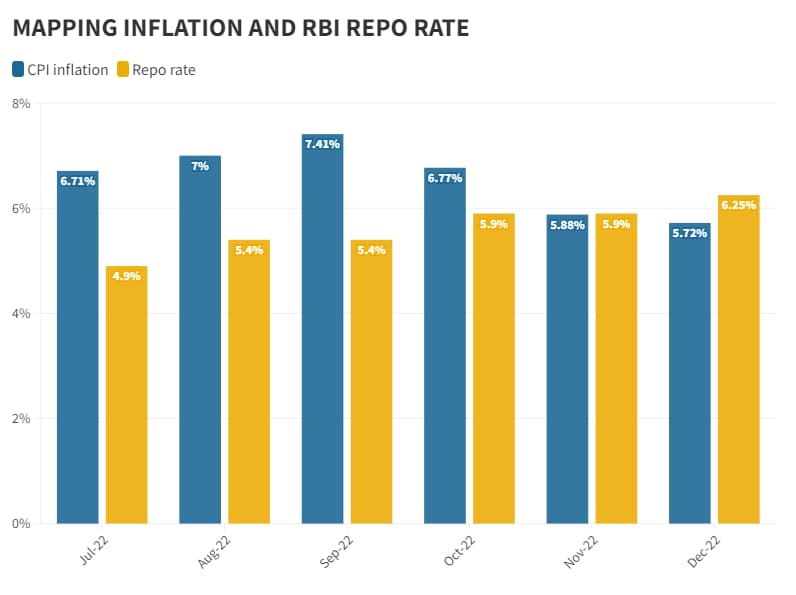

Worst of inflation behind us? According to JPMorgan analysts, the main short-term reasons arguing against chasing the rally right now are its speed and magnitude. Based on its analysis of risk appetite for emerging currencies, “some near-term caution is warranted.”
Top global market analysts have expressed caution that the early 2023 rally in developing-economy assets is already starting to lose some momentum and that it may not be time to go all out with buying.
This is even as the Reserve Bank of India (RBI) governor Shaktikanta Das has said the latest data points on growth, inflation and currency volatilities indicate the worst for financial markets and the world economy is behind us and US Fed Chair Jerome Powell has said: “the disinflationary process has started.”
However, Powell has signalled that interest rates would continue rising and that cuts were not in the offing. India’s Das too has said high-interest rates for a longer period look a distinct possibility going forward.
Here’s why several experts believe the world markets may not be able to get the better of inflation yet
Stock markets
– Angus Bell, managing director at Goldman Sachs Asset Management in London, told Bloomberg, “We aren’t in the environment just yet where can indiscriminately buy…For countries that faced acute stress last year, it’s not really as though the macro environment has shifted so dramatically that all of the problems that they were facing have now totally evaporated.”
– According to a note by JPMorgan analysts including Jonny Goulden on January 26, the main short-term reasons arguing against chasing the rally right now are its speed and magnitude. Based on its analysis of risk appetite for emerging currencies, “some near-term caution is warranted.”
– Reflecting on the volatility and uncertainty, Bloomberg cited the example of developments around Gautam Adani’s Adani Group following which the Indian market has been witnessing choppy trade. This, it said, is in sharp contrast with a stellar start to 2023 for the asset class, with Morgan Stanley Investment Management saying the decade of emerging markets had begun.
– Arvind Sanger, Geosphere Capital Management, said his problem with the inflation data is not that it’s not coming down, but that it may not come down to the levels that the market is hoping for, which would mean the Fed is starting to cut interest rates towards the end of the year. “That remains the big question,” he told CNBC-TV18.
–Badrinivas NC, Market Treasurer-Asia Pacific at Citi Bank said that from a going forward perspective, core inflation is something which continues to remain sticky.
“I mentioned about the strong continued growth momentum, I would think that on the balance MPC would like to keep its options open till you get more conviction on the trajectory of inflation, especially core inflation.”Badrinivas told CNBC-TV18.
– Aswath Damodaran, Professor – Finance, NYU Stern School of Business explained that the concern is there is something pushing stock prices up with no counter from the other side.
“I would have an issue with the kind of unquestioning bullishness that’s gone into pushing the price up. This is not a retail stock, so you can’t blame retail investors, but there’s something that’s pushing the price up with no counter on the other side… it is troubling to me that the market would let the price go up that much for a company that you look at and say that company, you shouldn’t see this much of a jump in the price over a short period.”
Food inflation
A United Nations’ index of food-commodity costs fell 0.8 percent in January, a 10th straight drop and the longest run in data going back to 1990. Prices have slipped 18 percent from a record in March, when Russia’s invasion of Ukraine disrupted crop flows from the major supplier.
– Still, the UN gauge remains historically high and it takes a while for changes to filter through to what people pay at the grocery store. Those shelf prices have soared around the world on the back of high energy, transport and labour costs, adding to the cost-of-living crisis and worsening global hunger, the report added.
– A Sky News report argues that all the primary factors in global inflation – war, energy and post-Covid supply chains – coalesce in food production, pushing up the cost of feed, fuel and fertiliser. That makes pricier grocery bills inevitable and has a disproportionate impact on the least well-off, for whom food is a greater proportion of spending.
US job market
– Sanger of Geosphere Capital noted that goods inflation has come down, even some of the real estate inflation but the big challenge for the Fed is to get the labour inflation not to prove to be stubborn.
– “That will prove to be the real question mark from this data, whether the Fed is going to have to engineer a bigger slowdown to get a handle on wage inflation because that may remain one of the bigger problems for 23,” he said.
China reopening
– China’s swift reopening after nearly three years of COVID-19 curbs could provide a much-needed boost to global economic growth, but may also stoke inflation just as it has shown signs of falling back, a CNN report suggests.
The revival of the world’s second-largest economy — and its biggest consumer of commodities — threatens to push up global prices for fuel, industrial metals and food this year, according to this report.
— Simply put, when demand is greater than supply, prices go up and vice versa when supply is greater than demand. This means, with China starting to manufacture again, supply-side hassles should ease. However, this may impact crude prices if Chinese demand rises simultaneously and this could lead to a rise in prices.
Meanwhile, banks in China are offering cheap consumer loans as President Xi Jinping has called for expanding consumer demand.
(With text inputs from agencies)
(Edited by : Abhishek Jha)
First Published: Feb 7, 2023 8:07 AM IST
Source: cnbctv18.com