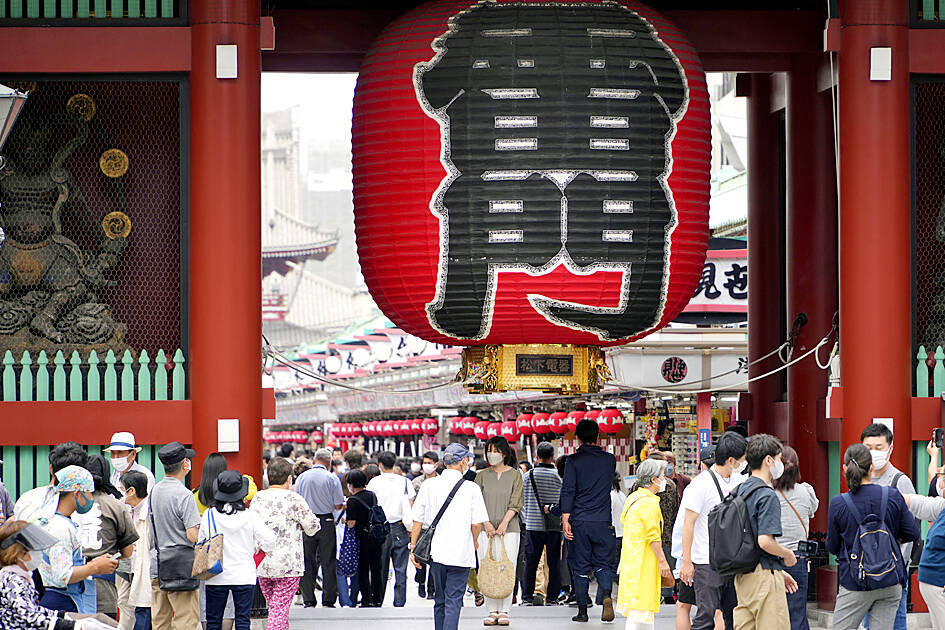

Japan and Australia are standouts among major economies, with relatively healthy consumption on the back of more mild inflation that is keeping a floor under spending power, according to Goldman Sachs Group Inc research.
A metric of consumer health used by Goldman analysts led by Jan Hatzius shows the two Asia-Pacific giants stand at about the 60th percentile, compared with about 40th percentile for the US and 35th for the eurozone.
The percentile refers to data comparing each country to itself, going back to 2000.
Photo: EPA-EFE
“Real spending growth has slowed substantially in North America and Europe, but remains solid in Japan and Australia given later reopening and less elevated inflation,” the analysts wrote in a report on Sunday, measuring the UK and Canada in addition to the four others.
The overall consumer health standings show a rare distinction for Japan and Australia, whereas much of the data show all six economies bearing similar characteristics.
On the upside, all are still seeing low unemployment, with rates having only edged up recently in the US and Canada. Household net worth as a share of income ranks in percentile 90 or higher in all of them, with debt service ratios broadly mild.
More troublingly, elevated inflation has crushed real income growth across those economies, where it has fallen to the 30th percentile or less. That has sent consumer confidence to a similar percentile in all economies except the US.
The Goldman analysts focused on seven gauges of consumer health: real spending growth, unemployment rate, real income growth, consumer confidence, debt service ratio, net worth-to-income ratio and real net worth growth.
Separately, soaring consumer price growth is the greatest threat for German output, German Minister of Finance Christian Lindner said.
“Prices are soaring, that’s the biggest danger for economic growth — it undermines the substance of our economy,” Lindner told German public broadcaster ARD in an interview on Sunday. “But we cannot fight inflation with borrowed money as we did with the corona pandemic.”
Germany’s inflation rate hit 8.8 percent last month — the highest level since the euro was introduced — fanned by soaring power prices.
Bundesbank AG president Joachim Nagel has repeatedly said that consumer price growth could hit double digits later this year and on Saturday warned that Germany faced a “tough winter.”
Lindner’s pro-market Free Democrats are part of German Chancellor Olaf Scholz’s ruling coalition, which has pledged about 100 billion euros (US$99.74 billion) in assistance measures to protect households and companies from soaring prices.
Still, the finance minister has repeatedly said that Germany must return to constitutional rules limiting borrowing known as the “debt brake” next year.
“Fighting inflation is always associated with a temporary economic slowdown, but that’s the price of stopping this inflation,” Lindner said.
“What we can do is protect healthy companies, healthy livelihoods” and “we must cushion people’s social hardships: No one will freeze in winter or go hungry for financial reasons,” he said. “But we cannot work with borrowed money like we did during the coronavirus pandemic.”
Comments will be moderated. Keep comments relevant to the article. Remarks containing abusive and obscene language, personal attacks of any kind or promotion will be removed and the user banned. Final decision will be at the discretion of the Taipei Times.
Source: taipeitimes.com